|
Martin
County was formed February 1, 1820 and was named after one of
the three individuals; Major Martin, Major Thomas Martin, or
John P. Martin, all of Kentucky.
The
earliest signs of civilization in the county, dates between
750 and 1500 A.D. They were the prehistoric Indians and they
lived in the bluffs above the river. Some of the early settlers,
along with the Shawnee, Delaware, Kick-a-poo, and Miami Indian
Tribes, were the Irish, Germans, English, and possibly French.
After the war of 1812, they began to immigrate to Martin County
from New York, Massachusetts, Pennsylvania, and Kentucky. They
were drawn to Martin County because of the river power for trading
and for their mills, the good rich farmland, and the timber.
The
first county seat was at Hindostan because it was the largest
town in the county. It was also on the New Albany-Vincennes
stagecoach route, which was the first stagecoach route in Indiana.
Hindostan had a population of 33 "Heads of Family"
in the 1820 census. In the fall of 1820, an illness plagued
the town and nearly wiped out the population, either by death
or moving away. It appears the illness was Yellow Fever caused
from the bite of a mosquito.
The
town continued to exist because of the stage route and the waterpower,
which produced power for stone, grist and sawmills. Many travelers
passed through Hindostan, including the Indiana Territorial
Governor, Wm. Henry Harrison. The town had a ferry, owned by
Wm. Harris, that crossed White River. Other businesses were
taverns, churches, merchantiles, and blacksmiths along with
the mills. By 1825, only 3 of the original 33 Heads of Family
remained. Today, there are no signs of an existence of the town
of Hindostan, except for the town cemeteries filled with the
families lost to the Yellow Fever.
Across
the river from Hindostan was a small town named Greenwich. The
French traders came here to trade goods with the Shawnee Indians.
In 1823 the White River flooded Greenwich and the town was dissolved.
The people moved to higher ground. They went to a community
called Mount Pleasant. Because of the population of Mount Pleasant
and the unhealthy conditions at Hindostan, the county seat was
moved to Mount Pleasant in 1828, where it remained until 1844.
The town became prosperous with 30 homes, 3 churches, a courthouse,
jail, post office and several merchants. The stage route came
through Mount Pleasant and stopped at a home built by a Mr.
Lewis Brooks in 1832.
A
new community was platted in 1853 and the Ohio and Mississippi
Railroad came through it. The people of Mount Pleasant began
to move away and into the community. This was the beginning
of the end of Mount Pleasant and the stagecoaches through Martin
County. This new community was two miles north, and was called
Loogootee. Loogootee remains the largest and only city in the
county, but never the county seat.
It was a major railroad center for freight coming into the area
and also livestock being shipped to larger cities in the East
and West. After moving the county seat from Mount Pleasant,
the new county seat would be Trinity Springs, known for its
natural health spas. Again, the county seat did not remain in
Trinity springs. In all, it was moved a total of 9 times, more
than any other county in the state of Indiana. The last and
final move of the county seat was to Shoals on the White River,
approximately 8 miles from Hindostan. The year was 1871. In
1876, a fire destroyed the original courthouse. Records were
stored in fireproof vaults, so we still have the early records
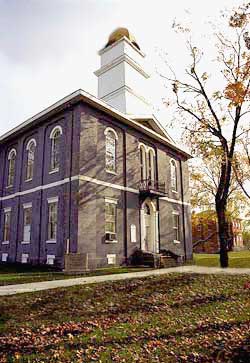
of our county. The present courthouse was built in 1877 and
is still in use today.
|
Martin
County had some notorious
citizens in the 1880's. They were named Archer and
they were not up right, law-abiding citizens. In fact, they
were robbers and supposedly
murderers. The were finally lodged in the Martin County
jail in March of 1886. The People of the community took
the law into their own hands, and on the night of March
9, 1886, they broke into the jail, locked up the sheriff,
took the prisoners onto the court house lawn, and with ropes
in hand, lynched the Archer Gang. At 1:00 am, the court
house bells rang to alert the towns people to witness the
archer's hanging on the court house lawn, where they remained
hanging until noon of the next day. After the hanging, life
in Shoals and the surrounding communities finally began
to approach a point of normalcy. The county seat began to
grow, and today Shoals has a population of nearly 1200 people.
|
Today
in Martin County, the timber is still being harvested, the farmers
still plant corn, and the White River still flows through Shoals
and past the once bustling little communities of Hindostan and
Greenwich.
|


 |
Home | Compare Plans | Sign
Up | E-Mail
|
Home | Compare Plans | Sign
Up | E-Mail